
Key Takeaways:
- The highest interest rate does not always deliver the strongest long-term investment returns.
- Successful investing balances returns, risk, inflation, tax efficiency, and your financial goals.
- Diversified portfolios often outperform chasing the highest interest rate over the long term.
- Real investment value comes from sustainable wealth creation, not headline interest rates.
- Choosing investments that match your goals is more important than selecting the highest return.
- Professional financial advice helps you make smarter investment decisions for long-term wealth creation.
How to Evaluate More Than Just the Highest Interest Rate Investment
When comparing the best investment options, it’s easy to assume that the investment offering the highest interest rate must also be the smartest choice. After all, a higher percentage appears to promise greater returns.
However, successful investing in South Africa involves far more than chasing the highest advertised yield. The real value of an investment lies in how it supports your financial goals, manages risk, protects your purchasing power against inflation, and contributes to long-term wealth creation rather than simply leaving your money in a bank account.
Whether you’re investing for retirement, growing family wealth, or preserving capital, understanding what makes one investment better than another is essential.
Explore Wealth Management Services by Firebird.
Why the Highest Interest Rate Can Be Misleading
Many people compare investments based on the advertised interest rate, but interest is only one way investments can generate returns. Many long-term investments build wealth through capital growth, dividends, or a combination of income and asset appreciation.
An investment offering a higher advertised return may seem more attractive than one offering a lower return, but higher potential returns often come with increased risk, higher fees, limited access to your money, or greater exposure to market fluctuations.
Before choosing between the best investment options, ask yourself:
- How much risk am I taking?
- Will inflation reduce my real return?
- Can I access my money if needed?
- How is the investment taxed?
- Does this investment support my long-term financial plan?
Looking beyond the headline interest rate helps investors make more informed decisions.
Before committing to any investment, it’s worth understanding the questions to ask your financial adviser to ensure the recommendation aligns with your financial objectives.

Factors That Matter More Than Interest Rates
Investment Risk
Generally, higher potential returns are linked to higher levels of risk.
Some investments may promise exceptional returns but expose investors to significant capital losses during market downturns, unlike the relative security often associated with a traditional bank savings account.
A balanced portfolio considers both growth opportunities and downside protection.
Inflation
Inflation quietly erodes purchasing power over time.
| Investment | Interest Rate | Inflation | Real Return |
| Investment A | 10% | 6% | 4% |
| Investment B | 8% | 2% | 6% |
Although Investment A offers the higher interest rate, Investment B provides the stronger real return after inflation.
This illustrates why experienced investors focus and calculate on wealth growth rather than simply chasing the highest percentage.
Liquidity
Some investments lock your money away for several years.
Others provide daily or monthly access.
Choosing the right investment depends on whether you are saving for:
- An emergency fund
- A property purchase
- Children’s education
- Retirement
- Long-term wealth accumulation
Liquidity should match your financial objectives.
Tax Efficiency
Taxes can significantly reduce investment returns.
Certain investment structures available when investing in South Africa, such as Tax-Free Savings Accounts (TFSAs), offer valuable tax advantages that can improve long-term outcomes.
Looking only at the advertised interest rate ignores the impact tax may have on your overall return.
What Are the Best Investments for Long-Term Wealth Creation?
There is no universal investment that suits every investor.
Instead, the best investments are those that match your:
- Financial goals
- Investment timeframe
- Risk tolerance
- Income requirements
- Existing assets
Examples may include:
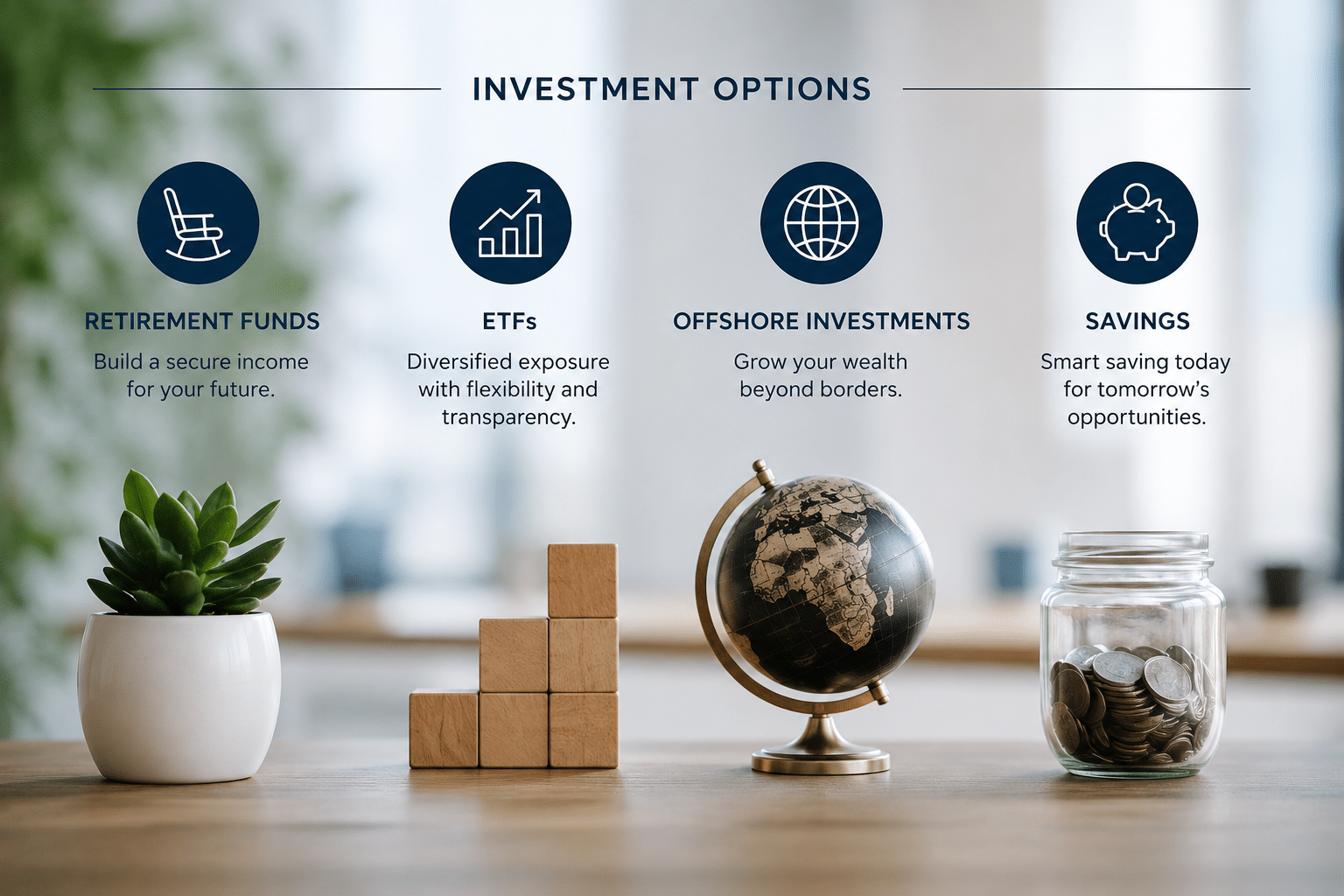
- Diversified unit trusts
- Exchange traded funds (ETFs)
- Retirement annuities
- Tax-Free Savings Accounts
- Balanced investment portfolios
- Offshore investments for global diversification
- Fixed-income investments for stability
Each plays a different role within a diversified financial strategy, and none can guarantee the best outcome in every market condition.
Why Diversification Beats Chasing High Returns
One of the biggest mistakes investors make is placing all their money into a single investment simply because it appears to earn the highest return.
Diversification spreads investments across different asset classes, industries and regions to reduce overall risk.
For example, rather than investing only in South African shares, a diversified portfolio may include local and global equities, bonds, property, and cash. If one asset class underperforms, others may help balance overall returns.
Rather than asking:
“Which investment has the highest interest rate?”
A better question is:
“Which combination of investments gives me the best opportunity to achieve my long-term goals?”
This approach helps protect portfolios during periods of market volatility while allowing investors to benefit from different sources of growth.
How Financial Advisory Supports Better Investment and Savings Strategies
Choosing between different investment management companies or investment products can feel overwhelming.
Professional financial advisory services help investors:
- Understand their risk profile
- Set realistic financial goals
- Build diversified portfolios
- Review investments regularly
- Adjust strategies as life changes
- Balance growth with capital preservation
Good investment advice focuses on your personal circumstances rather than simply recommending whichever product currently offers the highest return.
At Firebird, investment planning forms part of a holistic wealth strategy that considers tax planning, retirement, estate planning, insurance, and business interests to create lasting financial security.
When a Lower Return Can Actually Be the Better Investment
Sometimes accepting a slightly lower return can produce a stronger financial outcome.
Examples include investments that offer:
- Lower investment risk
- Better tax efficiency
- Greater liquidity
- More consistent long-term performance
- Better diversification
Over decades, consistency often outperforms chasing the highest advertised returns.
Successful investors understand that building long-term wealth is about making disciplined decisions repeatedly rather than searching for quick wins.

Save Smarter and Invest with Confidence
The investment offering the highest interest rate is not necessarily the investment that will deliver the greatest long-term value. Factors such as investment maturity, liquidity, tax efficiency, risk, and overall portfolio diversification can all influence your actual financial outcome.
True financial success comes from selecting investments that align with your goals, manage risk appropriately, protect against inflation, and support sustainable long-term wealth creation.
Working with experienced professionals allows you to build an investment strategy designed around your life, balancing returns, risk, investment maturity, and access to your money rather than simply following short-term market trends.
Book a consultation with Firebird today and discover how a personalised investment strategy can help you build lasting wealth.
FAQs
Is the investment with the highest interest rate always the best?
No. Higher interest rates often come with higher levels of risk, lower liquidity or tax implications. The best investment depends on your overall financial objectives.
What are the best investments in South Africa?
The best investments vary depending on your goals but often include diversified portfolios, retirement annuities, unit trusts, ETFs, tax-free savings accounts and carefully selected offshore investments.
Why is diversification important?
Diversification reduces overall portfolio risk by spreading investments across different asset classes and markets instead of relying on a single investment.
Should I seek professional investment advice?
Yes. Professional financial advisers help you choose investments that suit your objectives, risk tolerance and long-term financial plan while avoiding costly mistakes.